.jpg)
How Sun Bear Industries designed and delivered North Dakota’s first fully off-grid commercial solar-plus-storage microgrid for the MHA Nation’s Buffalo Campus at Twin Buttes, a system built for multi-generational energy sovereignty.
For decades, North Dakota has ranked last among all fifty states in installed solar capacity. Not for lack of sun. The state receives more hours of sunlight annually than any other state along the Canadian border. The challenge has been policy, infrastructure, and economics.
With some of the lowest electricity rates in the country, coal and wind dominating the grid, and utility policies that historically discouraged distributed generation, solar has remained an afterthought in the state’s energy mix.
In 2026, Sun Bear Industries completed what is believed to be the first fully off-grid commercial solar-plus-storage microgrid system in North Dakota. Not on a suburban rooftop. Not tied to a utility. Deep in the remote prairie landscape of the Fort Berthold Indian Reservation, serving the Buffalo Campus of the MHA Nation’s Twin Buttes community.
Where Energy Sovereignty Meets Cultural Restoration
The Buffalo Campus at Twin Buttes isn’t just a facility. It’s a living expression of the MHA Nation’s commitment to cultural continuity and self-determination.
The campus supports the MHA Nation’s buffalo program, part of a national movement to return the American bison to its ancestral homeland on tribal lands. Tens of millions of buffalo once roamed the Great Plains, central to the identity, sustenance, and spiritual life of the Mandan, Hidatsa, and Arikara peoples. By the late 1800s, unregulated commercial hunting and deliberate military campaigns reduced that population to fewer than a thousand animals.
Today, that story is being rewritten. The InterTribal Buffalo Council, partnering with the U.S. Department of Interior, the Department of Agriculture, The Nature Conservancy, and the World Wildlife Fund, has facilitated the relocation of thousands of buffalo from national parks, wildlife refuges, and conservation preserves back to tribal lands across the country.
The Buffalo Campus is where that future lives. It houses the operational infrastructure: equipment, water systems, and facilities that make buffalo stewardship possible in one of the most remote corners of North Dakota.
Powering the Prairie
.jpg&w=3840&q=75&dpl=dpl_3SF2tXnhiqBjfPCvCuBAPcAV5Pcb)
Twin Buttes sits in the South Segment of the Fort Berthold Reservation, a landscape of open sky, wide prairie, and limited infrastructure. Grid extension to remote facilities in this environment carries enormous cost. For the Buffalo Campus, diesel generation had long been the only option, requiring fuel to be trucked across long distances, creating cost volatility and operational risk, particularly through the region’s brutal winters.
Sun Bear Industries designed and engineered a solution from the ground up: a nearly 80 kW roof-mounted solar photovoltaic array paired with a large-scale battery energy storage system and a backup diesel generator, functioning as a fully independent microgrid with no utility connection required.
The system was engineered around a solar-and-storage-first philosophy. During daylight hours, the solar array generates power directly for campus operations while simultaneously charging the battery system with any surplus production. As solar output tapers in the evening or during low-irradiance periods, the battery seamlessly takes over, maintaining uninterrupted power without any external support.
The diesel generator, once the campus’s primary and only source of power, has been repositioned as a last-resort backup. The result is a dramatic reduction in fuel consumption, generator wear, and operational cost, while delivering a level of reliability that diesel alone could never provide.
A First for North Dakota and a Model for Indian Country
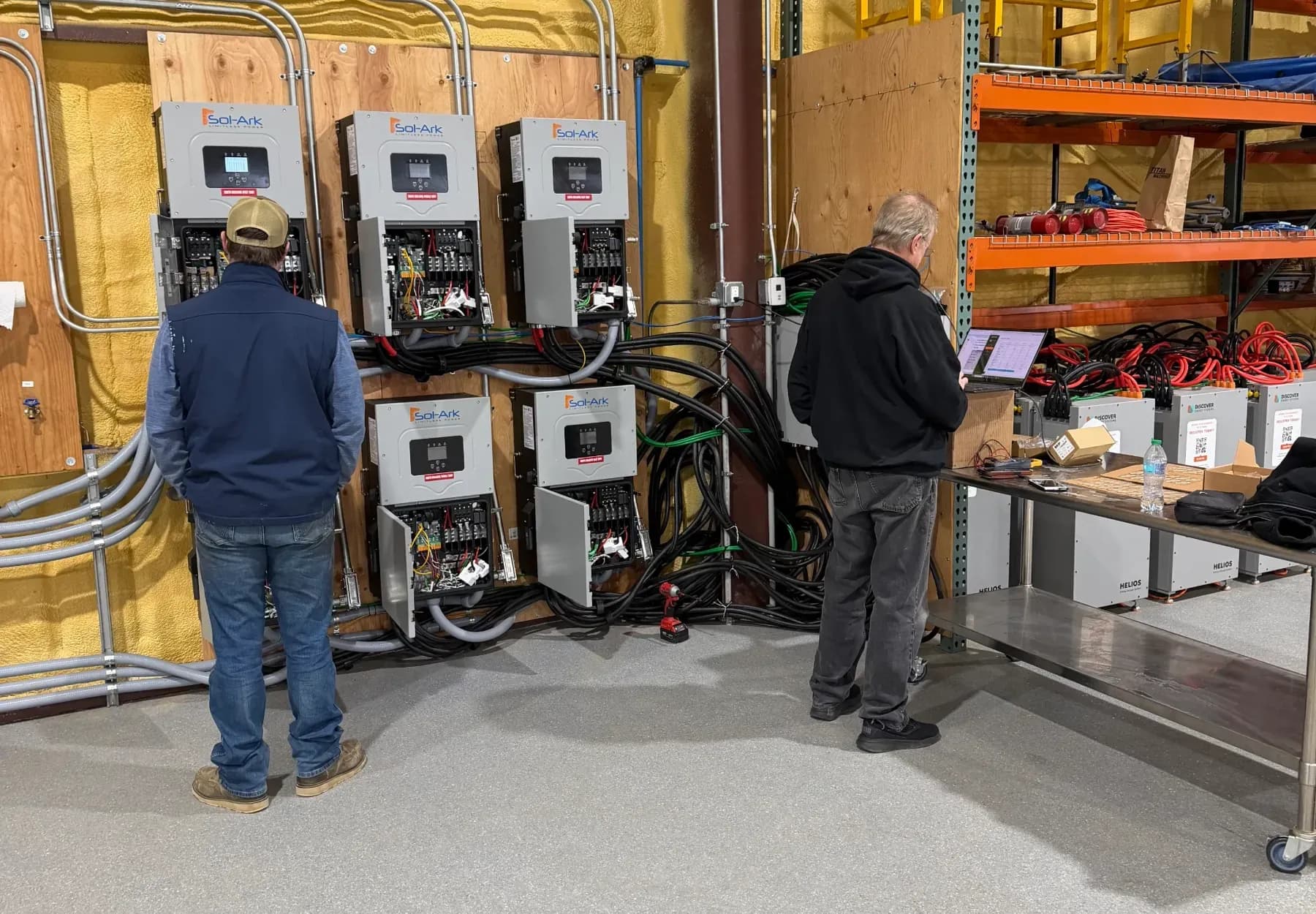
No project like this had been built in North Dakota before. In a state where solar adoption has lagged every other state in the union, the Buffalo Campus represents a proof of concept that reaches far beyond Twin Buttes.
The system demonstrates that advanced off-grid solar microgrids can be engineered to perform reliably in cold, low-irradiance climates. It shows that tribal communities in remote environments don’t have to choose between reliability and sustainability.
The Buffalo Campus system is replicable. Across the Midwest and Great Plains, dozens of tribal communities operate remote facilities: health clinics, cultural centers, agricultural operations, community buildings. All remain tethered to diesel because no one has offered them a better path. SBI has now built that path.
As the buffalo return to Twin Buttes, so does something else: the power to define what the future looks like. On their terms, with their energy, on their land.